
Last updated September 21, 2026
Full 25-point door and opener safety check with every visit - springs, cables, rollers, tracks, and your LiftMaster or Chamberlain opener included
You get a price before we start. It does not change when the truck arrives.
 Before
 After
After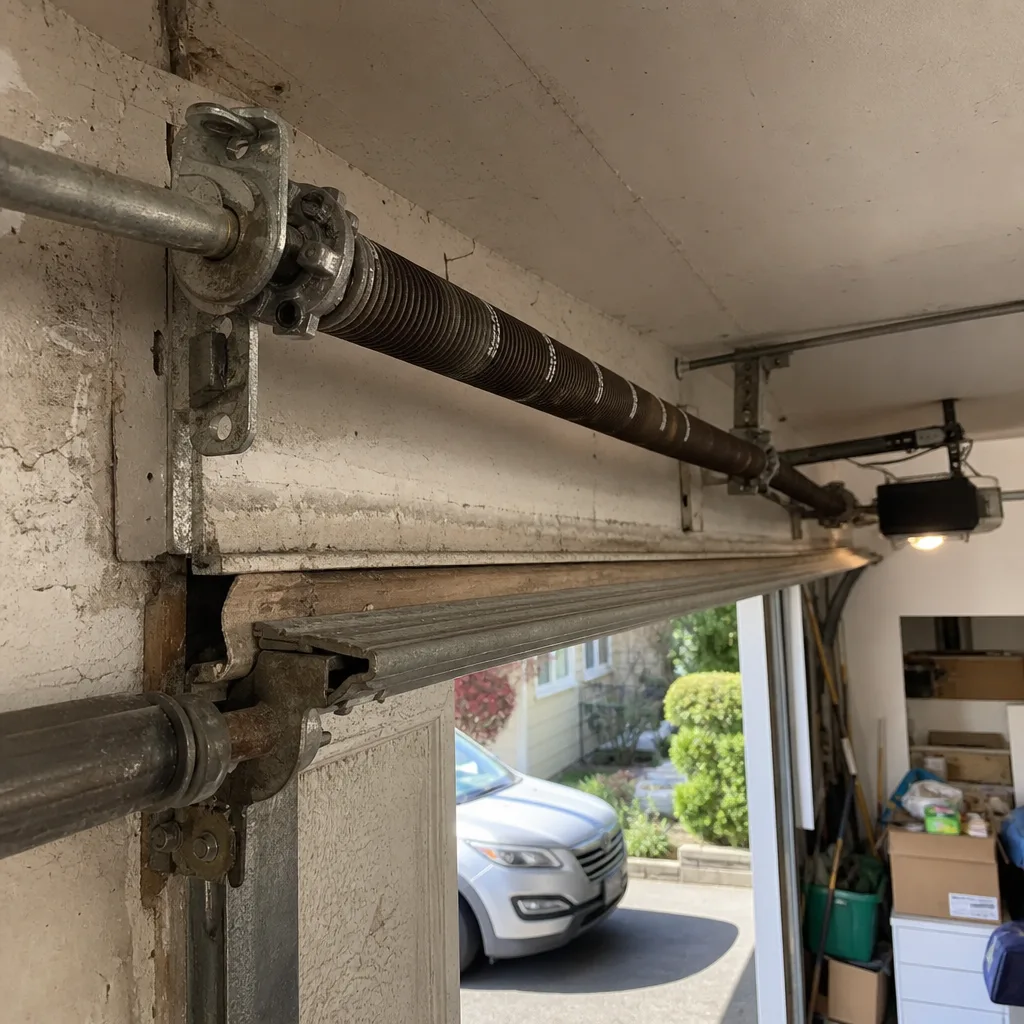 Before
 After
After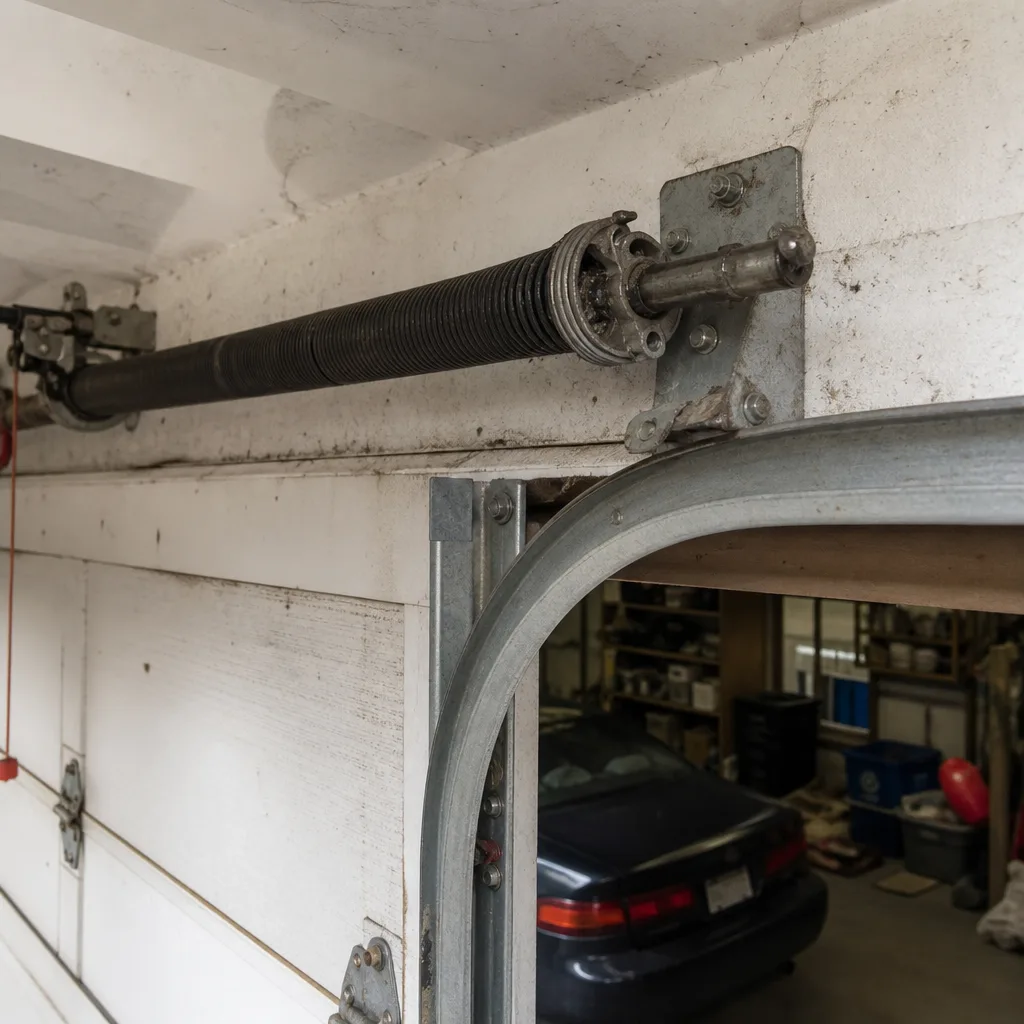 Before
 After
AfterSeasonal Garage Door Care for Redmond: Year-Round Homeowner’s Guide
Redmond averages 164 days of measurable precipitation per year, and the garage door bottom seal is the cheapest part on the entire door and the most commonly neglected. While generic maintenance calendars treat Seattle-area homes the same as Phoenix or Minneapolis, Redmond’s specific pattern - persistent winter dampness, a genuine dry window in July and August, and freeze-thaw cycles concentrated from November through February - creates wear patterns that don’t show up in national checklists. This guide maps what to do, when to do it, and what to watch for, calibrated to the climate data we see reflected in the repair calls we run across Redmond neighborhoods from Education Hill to Bear Creek. For a deeper dive, see The Complete Guide to Garage Door in Redmond.
Quick Answer
Redmond homeowners should perform garage door maintenance four times per year: a pre-winter inspection in October focused on seals and lubrication before temperatures drop below 40°F, a post-winter audit in March checking for freeze-thaw damage, a deep maintenance window in July-August for cleaning and paint touch-up, and a mid-winter check in January for opener battery backup performance. The bottom seal, weatherstripping compression, and torsion spring tension are the three components most affected by Redmond’s wet winters and should be inspected before and after each cold season.
Table of Contents
- October Pre-Winter: The Critical 30-Day Window
- Cold Weather Spring Behavior: Normal vs. Problem
- July-August: Redmond’s Dry Maintenance Window
- Spring Post-Winter Audit: What Freeze-Thaw Leaves Behind
- Opener-Specific Seasonal Notes
- Year-Round Habits That Prevent Emergency Calls
- Common Mistakes to Avoid
- When to Call a Professional
- Frequently Asked Questions
 Before
 After
AfterOctober Pre-Winter: The Critical 30-Day Window
October is the month that separates the garage doors that make it through Redmond’s wet season intact from the ones that don’t. By mid-October, average daily highs drop into the upper 50s, overnight lows approach 40°F, and the first sustained rains of the season have typically arrived. This is your last practical window to address three components before cold, wet conditions make them harder to service and more likely to fail.
Bottom Seal Inspection and Replacement Criteria
The bottom seal is a flexible rubber or vinyl strip mounted to the bottom edge of the door panel, designed to compress against the concrete threshold and block water, debris, and rodents. In Redmond, this seal sits in direct contact with standing water for months at a stretch during the wet season. We replace more bottom seals in January and February than any other two-month period, and the majority of those doors showed visible damage that was detectable in October.
Replace the bottom seal before winter if you observe any of the following:
- Visible cracking or splitting in the rubber, especially at the ends where water pools
- Compression set - the seal no longer springs back to its original shape after the door opens
- Light visible under the door when closed, indicating the seal isn’t making full contact with the threshold
- Hardness or brittleness when you press it with your finger; a pliable seal compresses easily, a failed seal feels like plastic
- Evidence of rodent chewing at the ends, common in Redmond’s wooded neighborhoods near Bridle Trails
Bottom seal replacement is straightforward on most sectional doors - the seal slides into an aluminum or plastic retainer channel - but selecting the correct profile matters. T-style, bead-style, and bulb-style seals are not interchangeable. If you’re uncertain, a technician can identify the profile and install the correct replacement in under 30 minutes. Garage Door Repair in Redmond covers seal replacement and other pre-winter services.
Weatherstripping Compression Test
The vinyl or rubber weatherstripping along the sides and top of the door frame (the jambs) creates a secondary seal. Over time, compression from repeated door cycles flattens the bulb or fin, reducing its ability to block wind-driven rain. In October, close the door and inspect the weatherstripping from inside the garage with the lights off - daylight visible anywhere along the jamb indicates a gap.
Perform the compression test: close the door on a strip of standard printer paper placed between the door and the weatherstripping. If the paper pulls out without resistance, the seal has lost compression. In Redmond’s wind-exposed hillside homes, particularly in areas like Redmond Ridge, this gap allows horizontal rain to penetrate the garage interior, accelerating rust on tools, bikes, and the door’s own hardware.
Lubrication Before Temperatures Drop
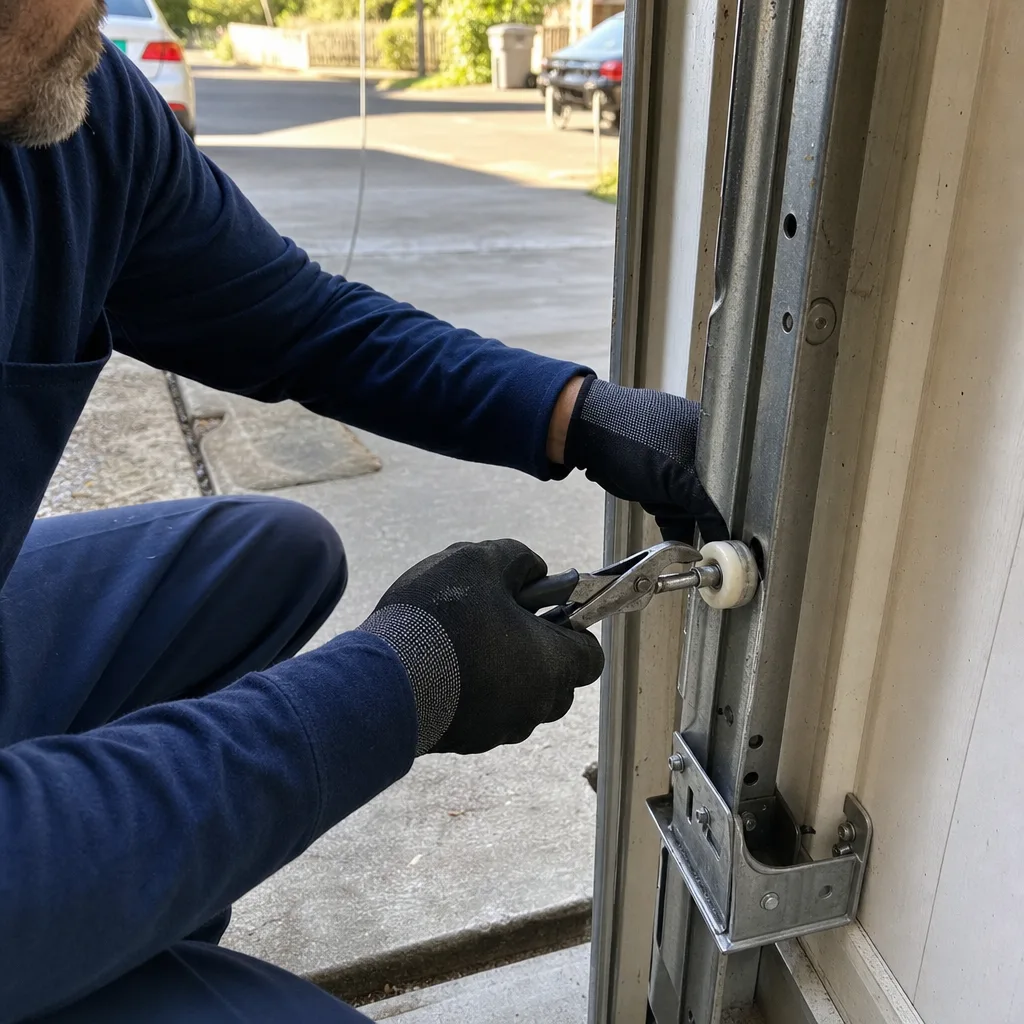
All metal-to-metal contact points should be lubricated in October, before temperatures consistently fall below 40°F. Below this threshold, standard garage door lubricants thicken, and application becomes less effective. The critical points are:
- Torsion spring coils (the large spring above the door) - use a lithium-based garage door lubricant, not WD-40
- Hinges at each panel joint - one drop per hinge pin
- Roller bearings inside the roller wheels - if your door has sealed nylon rollers, skip this; the bearings are internal and not serviceable
- Bearing plates at each end of the torsion spring tube
- Lock mechanism, if present
After lubricating, cycle the door fully open and closed twice to distribute the product. Wipe excess from the tracks - lubricant in the vertical tracks actually collects dust and grit, increasing roller wear.
Cold Weather Spring Behavior: Normal vs. Problem
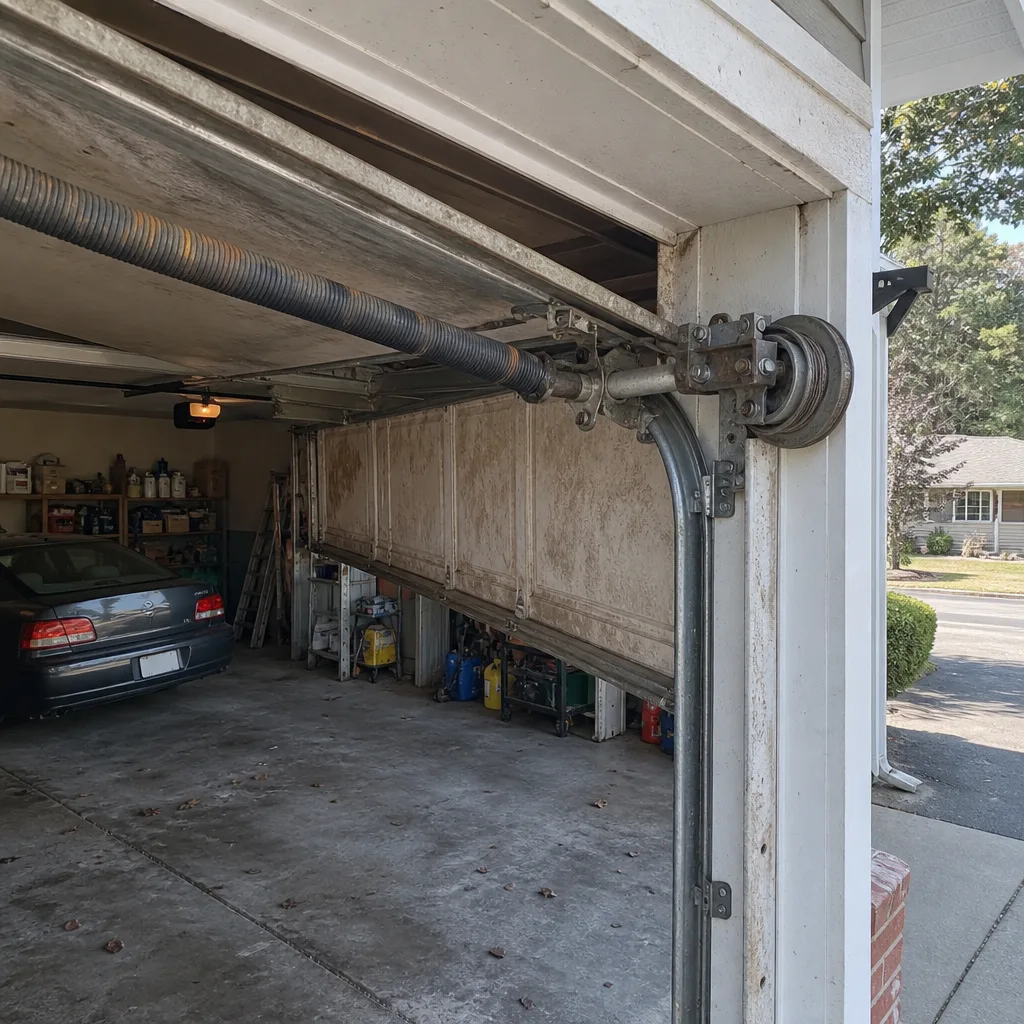
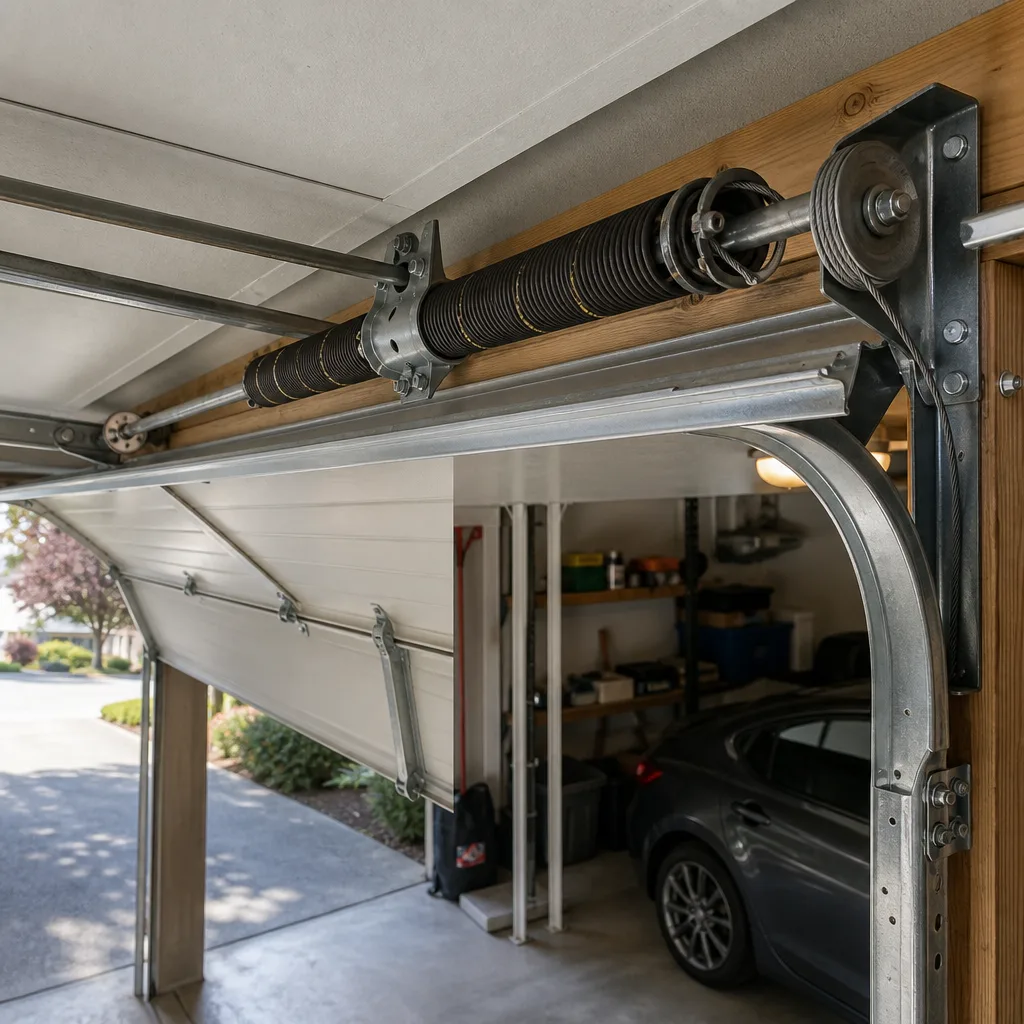
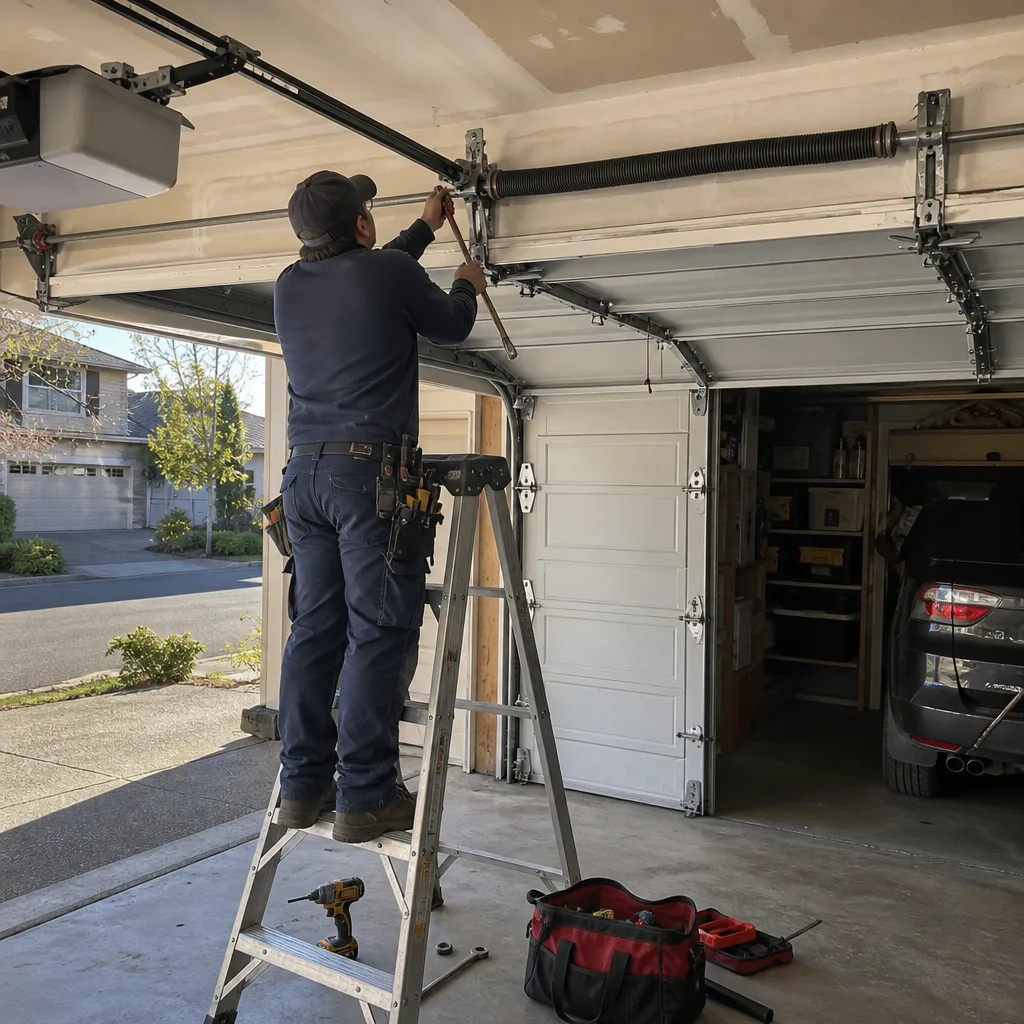
Torsion springs - the coiled steel springs mounted horizontally above the door that provide the counterbalance force - behave differently in cold weather. This is physics, not wear, but the distinction matters because Redmond homeowners often misinterpret normal cold-weather behavior as a failing spring and either live with unnecessary anxiety or pay for an unneeded adjustment.
Why Cold Weather Temporarily Increases Spring Tension
Steel contracts slightly as temperature drops. A torsion spring at 35°F has marginally less coil diameter and therefore slightly higher effective tension than the same spring at 70°F. The result: on the first cold morning of the season, your garage door may open more slowly, sound slightly different, or require marginally more force from the opener. This is normal and typically resolves as the garage interior warms during the day or as the door cycles and friction generates heat in the coils.
Distinguishing “Cold-Morning Slow Door” from a Spring That Needs Adjustment
The key diagnostic is consistency. A door that behaves normally by midday, or that returns to normal behavior once temperatures rise above 45°F, is exhibiting thermal response, not spring failure. A spring that actually needs adjustment or replacement shows these signs regardless of temperature:
- The door won’t stay open at waist height when disconnected from the opener and lifted manually - this indicates insufficient spring tension
- Visible gap in the coil - a broken torsion spring separates into two distinct sections with a clear gap; this is unmistakable and the door will not open
- Asymmetric lift - the door rises crooked, indicating one of two springs (on a double-spring system) has failed
- Opener strain - the opener labors, the light flickers, or the motor housing gets unusually warm; the opener is compensating for a spring that no longer carries its share of the door’s weight
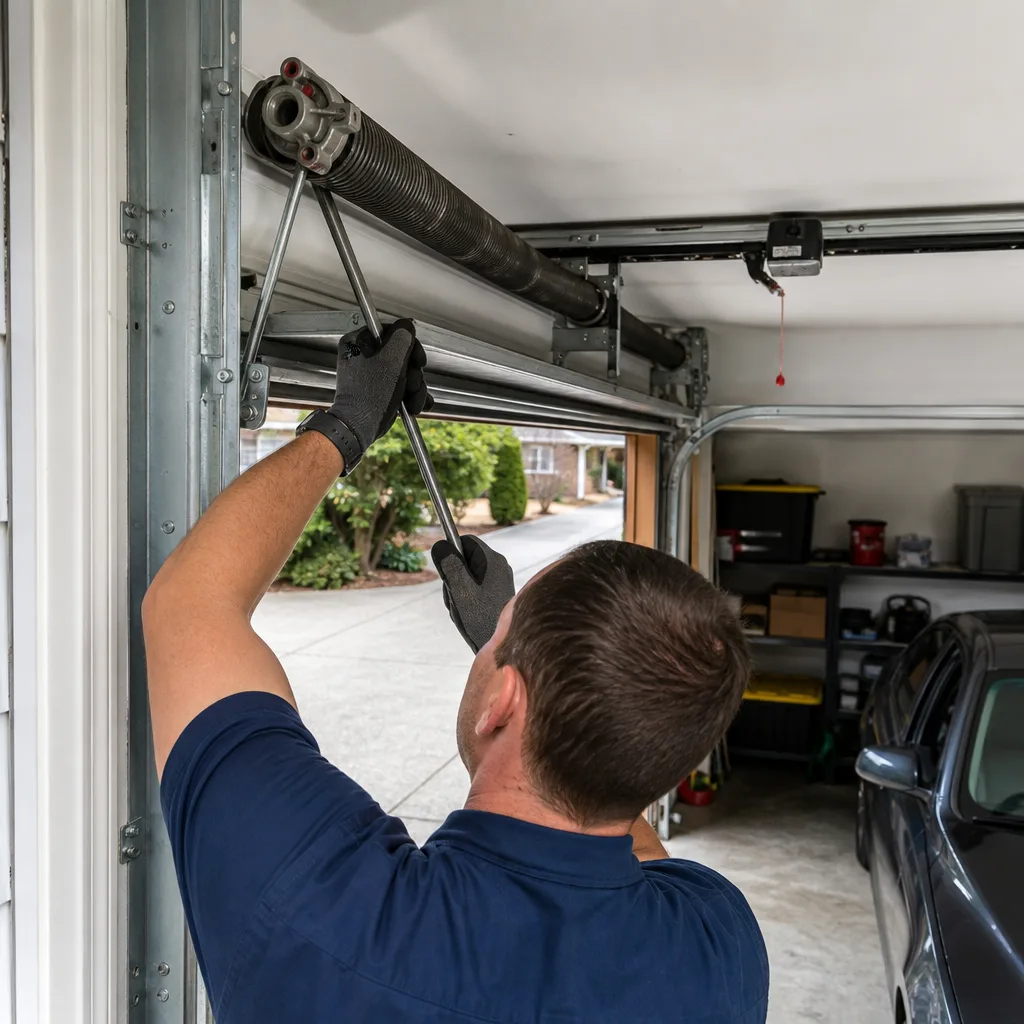
In our experience across Redmond, particularly in unheated garages in older neighborhoods like Downtown Redmond and Grass Lawn, we see a spike in “slow door” calls the first week of November. Many homeowners wonder whether to tackle issues themselves or call a pro - our DIY vs Professional Garage Door: The Redmond Homeowner’s Decision Guide can help you decide. Roughly 60% resolve with education about thermal behavior; the remaining 40% have genuine spring issues that we document with photographs before quoting replacement per Clause 4 of The Haven Standard. Torsion spring adjustment involves winding or unwinding significant stored energy and should not be attempted without proper training and tools. The wound spring can cause serious injury if mishandled.
July-August: Redmond’s Dry Maintenance Window
Redmond’s summer climate is genuinely distinctive in the Pacific Northwest context. July and August average less than one inch of precipitation each, with daytime highs in the upper 70s and overnight lows in the mid-50s. This is the only window of the year when you can reliably count on 48 consecutive dry hours - the minimum needed for paint curing, thorough track cleaning, and hardware work without immediate re-exposure to moisture.
Track Cleaning and Alignment
The vertical and horizontal tracks that guide the door rollers accumulate a paste of road grit, brake dust, and organic debris over the wet season. In July, with the door closed, clean the interior of both vertical tracks with a damp cloth followed by a dry cloth. Do not use lubricant in the tracks - the rollers are designed to roll, not slide, and oily tracks attract more debris.
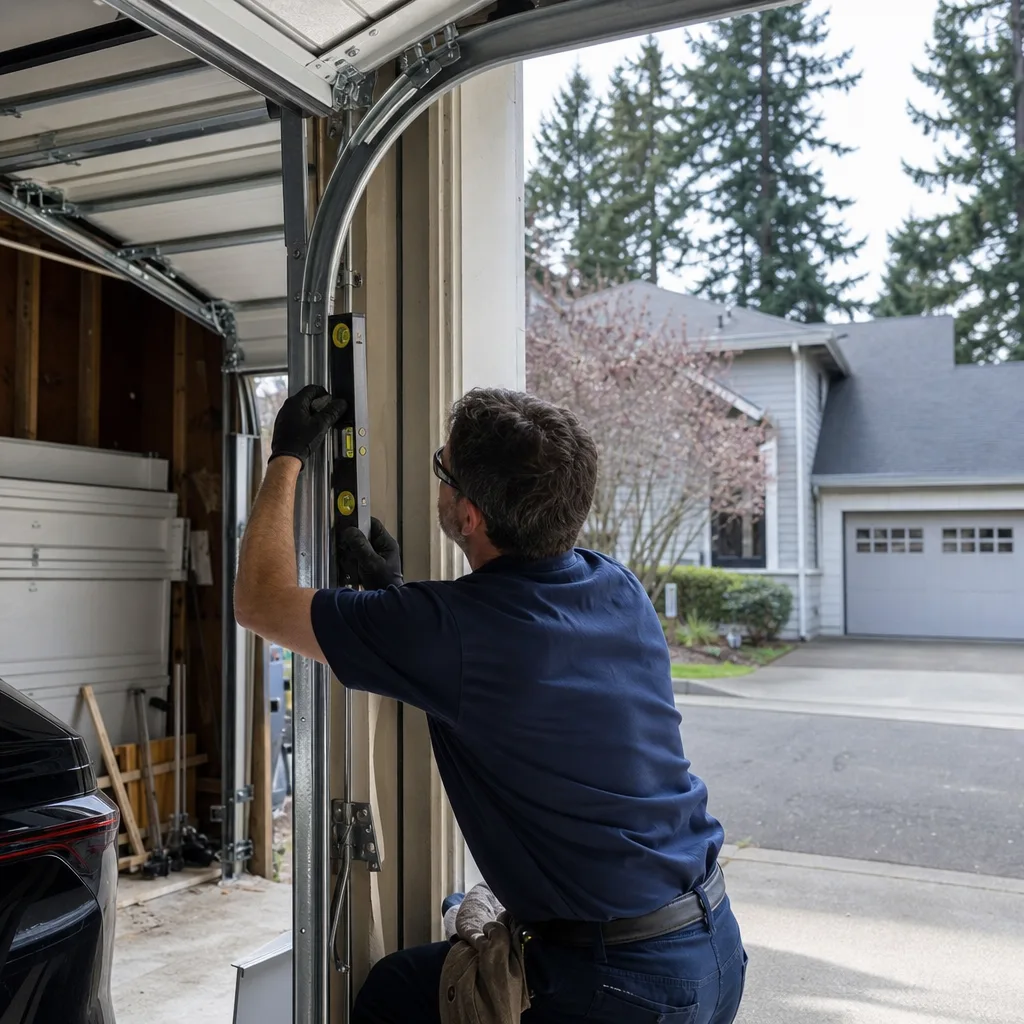
Check track alignment with a level: the vertical tracks should be plumb within 1/4 inch over their full height, and the horizontal tracks should slope slightly down toward the back of the garage (about 1/4 inch per 2 feet). Misalignment causes roller binding, opener strain, and eventually popped rollers. In Redmond’s newer construction, particularly in the Overlake and Southeast Redmond areas, we’ve noted that settlement in the first 3-5 years after construction often shifts track mounting brackets; July is the right time to detect and correct this before wet-season expansion and contraction make it worse. For expected costs on repairs like this, check our Garage Door Cost Breakdown: The Redmond Homeowner’s Reference for 2026.
Paint Touch-Up and Rust Prevention
Steel door panels develop surface rust at scratch points, bottom edges, and panel seams where the factory finish has worn. Sand rust spots to bare metal with 220-grit paper, apply rust-inhibiting primer, and topcoat with matching paint. Allow 24 hours dry time between coats - this is why the July-August window matters. Attempting this in October risks trapping moisture under fresh paint, accelerating rather than preventing corrosion.
For doors with wood-grain embossing (common on Amarr and Wayne Dalton steel doors), pay attention to the embossed valleys where water collects and the finish wears first. A small brush touch-up here extends panel life significantly.
Hardware Tightening
Vibration from daily door cycles loosens hardware over time. With the door closed, tighten all visible bolts:
- Hinge screws at each panel joint
- Track mounting brackets to the wall and ceiling framing
- Opener rail mounting hardware
- Bottom bracket fasteners (do not remove these - the cables are under tension)
Use a socket wrench, not a screwdriver, for hinge screws - the additional torque matters. Do not overtighten; snug plus 1/4 turn is sufficient. Stripped screw holes in hollow metal doors should be repaired with a threaded insert, not a larger screw, which will eventually pull through.
Spring Post-Winter Audit: What Freeze-Thaw Leaves Behind
By March, Redmond has typically experienced 15-25 freeze-thaw cycles - nights below 32°F followed by days above freezing. Each cycle causes moisture in panel seams, hardware crevices, and concrete thresholds to expand and contract, accelerating wear that isn’t visible until the weather clears.
Panel Seam Separation
Steel sectional doors have interlocking edges where adjacent panels meet. Water infiltration at these seams, followed by freezing, can deform the interlock profile or separate the factory sealant. Inspect each seam from inside the garage with the door closed: visible light, visible gaps, or rust staining at the seam edge indicates separation. Minor seam issues can be sealed with a polyurethane garage door sealant; significant deformation requires panel replacement. Catching this in March prevents the accelerated rust progression that occurs once April rains return.
Rust Tracking from the Bottom Bracket
The bottom bracket is the L-shaped hardware at each lower corner of the door that anchors the lifting cables and the bottom roller. It’s in direct contact with the threshold, and in Redmond’s wet season, it’s often submerged in standing water during heavy rains. By March, inspect the bracket for:
- Red-brown rust streaks running down the bottom panel from the bracket mounting bolts
- Bracket looseness or rotation when you grasp it by hand
- Cable fraying where it exits the bracket - moisture wicks up the cable and corrodes interior strands
Bottom bracket replacement involves releasing cable tension and should be performed by a trained technician. The cables are under significant load and can cause injury if improperly handled.
Cable Drum Groove Wear
The cable drums at each end of the torsion spring tube have helical grooves that wind and unwind the lifting cables as the door operates. Over a wet Redmond winter, corrosion products and debris accumulate in these grooves, causing uneven cable winding. In March, with the door closed, inspect the cable lay on each drum: the cable should seat cleanly in each groove without crossing over itself or bunching. Crossed or bunched cable indicates groove contamination or wear. A technician can clean or replace drums and re-tension the system.
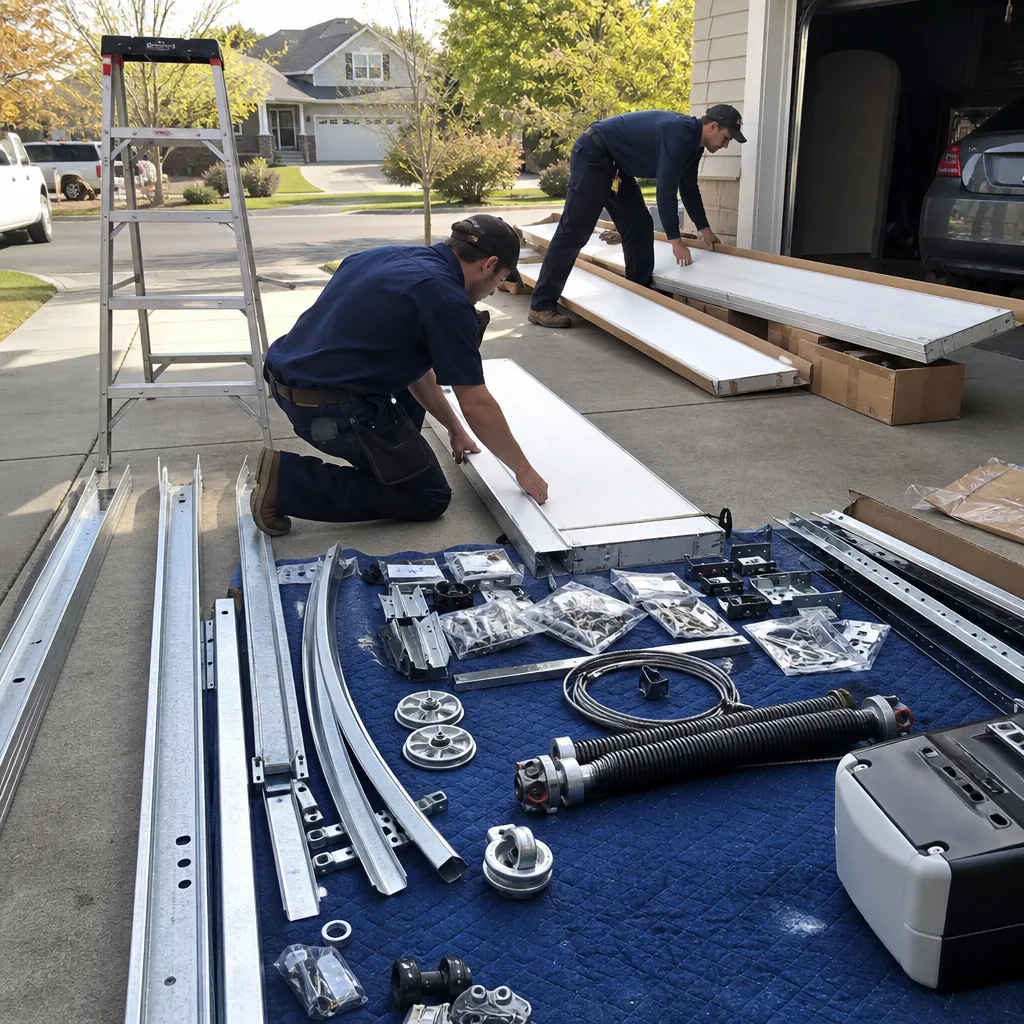
We document all three of these conditions - panel seams, bracket rust, and drum wear - with photographs during our spring audit calls, delivering the photo record to the customer before any quote per Clause 4 of The Haven Standard. Garage Door Installation in Redmond addresses full door replacement when panels or hardware are beyond serviceable condition.
Opener-Specific Seasonal Notes
Garage door openers have electronic and electromechanical components that respond to seasonal conditions in ways that mechanical hardware does not. Two issues are particularly relevant to Redmond’s climate pattern.
Battery Backup Units in Cold Weather
Since 2019, California-style battery backup requirements have influenced opener availability nationwide, and many Redmond homes now have openers with integrated battery backup units. These are typically sealed lead-acid or lithium-ion batteries mounted in the opener housing or a separate compartment.
Cold weather reduces battery capacity. At 32°F, a lead-acid battery delivers roughly 50% of its rated capacity; at 20°F, approximately 30%. In Redmond’s unheated garages, this means:
- The battery backup may fail to operate the door even once during a power outage in January, despite testing successfully in September
- Charging efficiency drops, extending recharge time after use
- Battery lifespan shortens - a battery that lasts 3 years in a heated space may fail in 18 months in an unheated Redmond garage
Test battery backup function in October and January: unplug the opener, then attempt to operate the door with the remote or wall button. If the door doesn’t open fully, or the battery indicator shows reduced capacity, replacement is indicated. We carry replacement batteries for all major brands including LiftMaster, Chamberlain, Genie, and Craftsman on our service vehicles.
Limit-Switch Calibration Drift
The limit switches in an opener - the electronic or mechanical devices that tell the motor when to stop at the fully open and fully closed positions - can drift seasonally. Two mechanisms cause this:
First, thermal expansion of the door and track system changes the physical open and closed positions by small but measurable amounts. A door that seals properly at 70°F may not compress the bottom seal fully at 35°F due to contraction of the panel sections.
Second, the opener’s force and travel settings are calibrated at installation to a specific door weight and balance. When spring tension changes seasonally (as described above), the opener’s effective load changes, and the motor may stop short of the programmed limit or overrun it slightly.
Symptoms of limit-switch drift include:
- Door reverses before fully closing, or reverses immediately upon contacting the floor
- Door stops 2-6 inches short of fully open, leaving a gap
- Opener light flashes in a pattern (typically 4-10 flashes, brand-dependent) indicating a limit or force error
Limit-switch adjustment procedures vary by brand and model - Raynor and Genie openers use different programming sequences, for example. Incorrect adjustment can damage the opener or create a safety hazard if the door fails to reverse on obstruction. If you’re uncertain of the procedure for your specific model, documented adjustment is included in our Garage Door Opener Repair & Installation in Redmond service.
Year-Round Habits That Prevent Emergency Calls
Beyond the seasonal tasks, three ongoing habits separate homeowners who call us every few years for routine service from those who call at 10 PM with a door that won’t close.
The Monthly Visual Inspection
Spend 60 seconds once a month with the door closed, lights on, looking at:
- Cables: any fraying, rust, or broken strands
- Springs: any visible gap in the coil, or rust that has progressed past surface discoloration
- Rollers: any roller that wobbles in the track, or nylon rollers that have cracked or lost their wheel
- Bottom seal: any new damage since last inspection
This takes less time than reading this paragraph. The value is pattern recognition - you notice when something changes, which is the most useful information you can provide when you do call.
The Balance Test
With the door closed, pull the emergency release handle (the red cord hanging from the opener trolley) to disengage the door from the opener. Lift the door manually to waist height and release it. A properly balanced door stays at waist height; a door that falls closed has insufficient spring tension; a door that rises on its own has excessive tension. Either condition strains the opener and creates a safety risk. Test monthly and call if the balance changes.
The Reversal Test
Place a 2×4 board flat on the threshold and close the door with the opener. The door should reverse within 2 seconds of contacting the board. If it doesn’t, the safety reversal system needs adjustment or repair. Federal law (UL 325) requires this function; a non-reversing door is a safety hazard, particularly for children and pets. Test monthly.
Our 18,000+ service records since 2015 show that homeowners who perform these three habits consistently average one preventive service call every 4-5 years, versus every 18-24 months for those who don’t. The documentation we provide - the written price before work starts per Clause 1, the photo record per Clause 4 - means you have a baseline for comparison at each visit.
Common Mistakes to Avoid
- Using WD-40 on torsion springs or hinges. WD-40 is a solvent and light penetrating oil, not a lubricant. It displaces water effectively but evaporates quickly, leaving metal surfaces unprotected. Within two weeks of application, friction increases and wear accelerates. Use lithium-based garage door lubricant or silicone spray formulated for this purpose.
- Ignoring the bottom seal until water enters the garage. By the time you notice water intrusion, the seal has been compromised for weeks and the threshold concrete may have absorbed enough moisture to accelerate rust on the bottom bracket and lower panel edge. In Redmond’s climate, replace the seal at the first sign of compression set or cracking, not after failure.
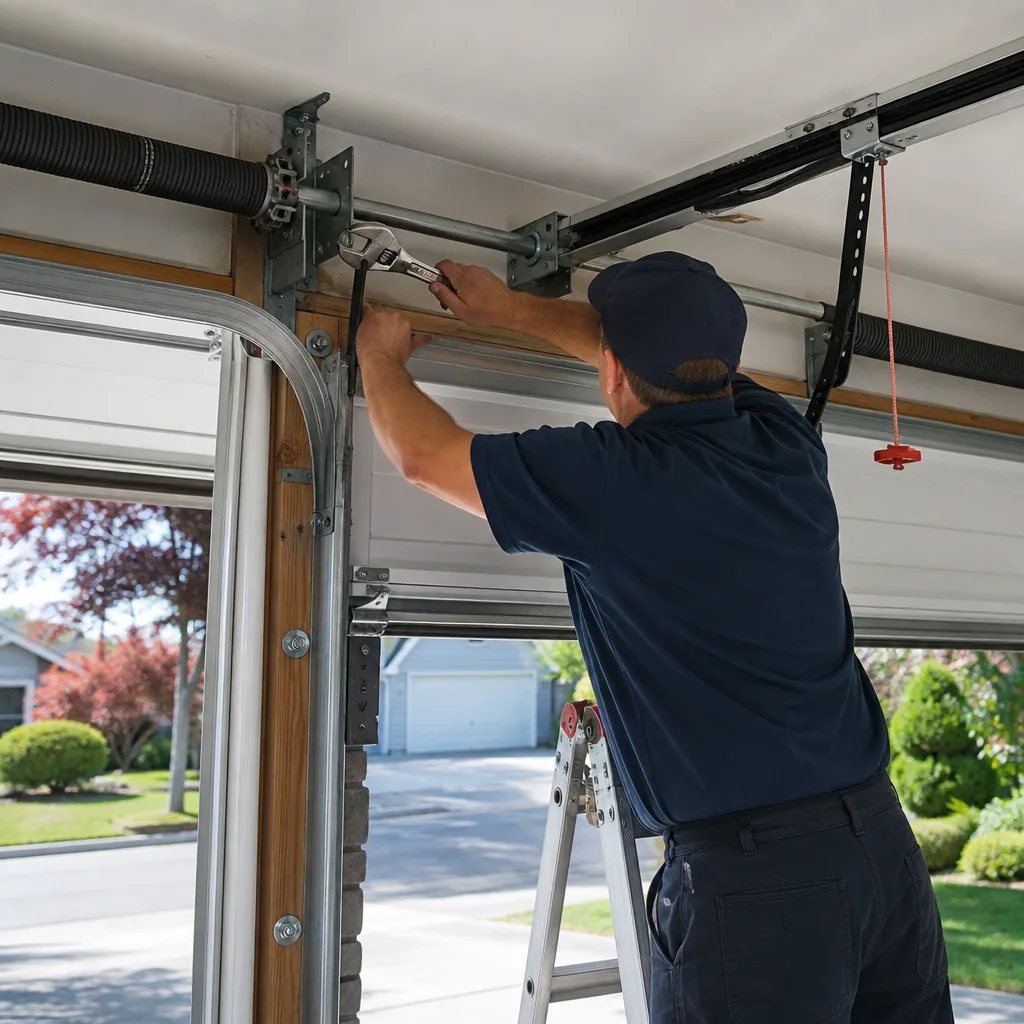
- Adjusting torsion spring tension without proper tools. Winding bars - solid steel bars inserted into the cogs of the winding cone - are mandatory for safe adjustment. Screwdrivers, pliers, or other substitutes can slip and release stored energy without warning. The force in a wound torsion spring can cause serious injury or death. This is not a homeowner maintenance task.
- Painting or sealing in marginal weather. Redmond’s October and April weather is tempting - cool but not freezing, occasionally dry for 24 hours. Paint and sealant need 48 hours minimum at 50°F+ to cure properly. Trapped moisture under paint creates the exact rust conditions you’re trying to prevent. Wait for July or August.
- Testing battery backup only in warm weather. A battery that tests fine in September may fail completely in January. Test when it matters, not when it’s convenient. Mark your calendar for January testing.
- Over-tightening hardware. Hinge screws and track brackets need to be snug, not torqued. Overtightening strips threads in hollow steel doors, cracks nylon rollers, and deforms track mounting brackets. Use a socket wrench and stop at “snug plus a quarter turn.”
- Assuming all brands use the same maintenance schedule. A Craftsman chain-drive opener from 2012 needs different attention than a current LiftMaster belt-drive with myQ connectivity. A Wayne Dalton TorqueMaster spring system (enclosed, counterbalance spring inside a tube) has no user-serviceable spring components at all. Know what you have, or have a technician identify it and document the specific maintenance points.
When to Call a Professional
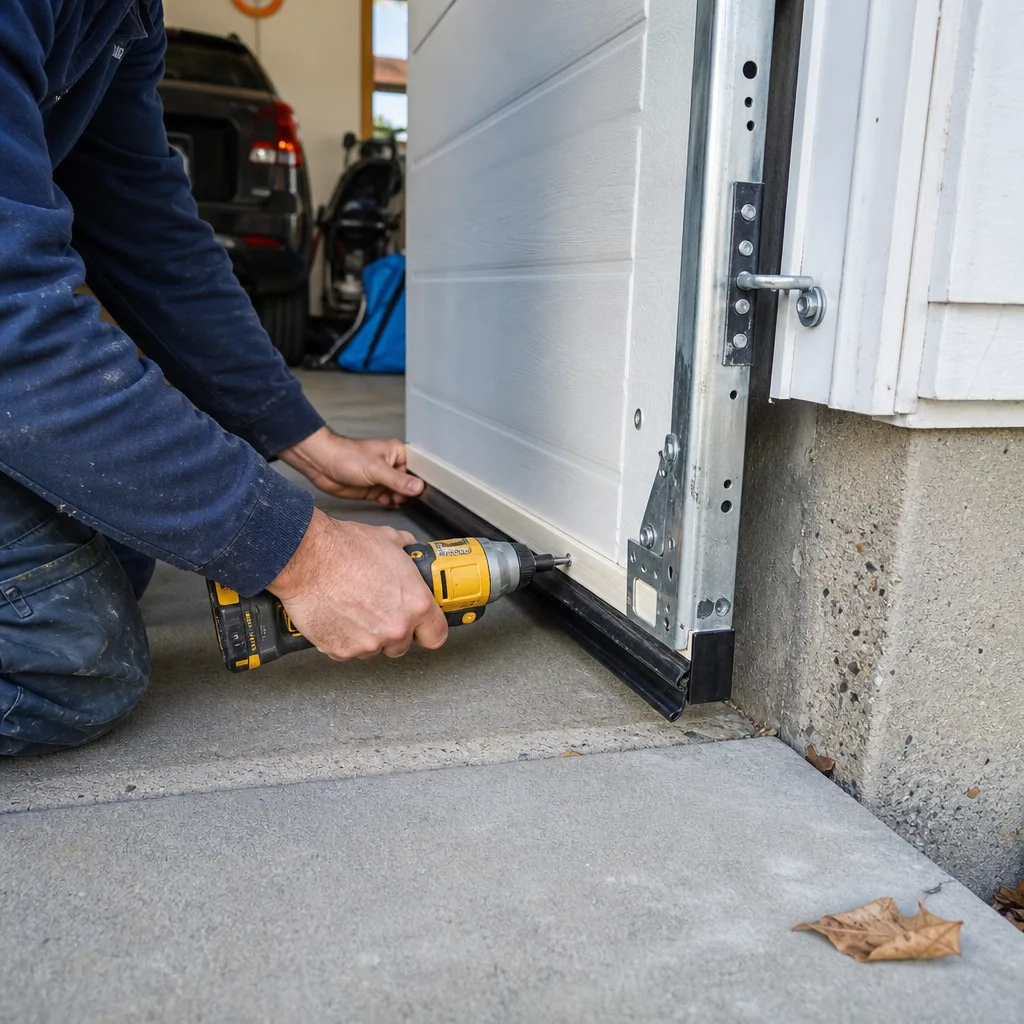
Some conditions require trained diagnosis and documented repair, not homeowner maintenance. Call for service if you observe: a broken torsion spring (visible gap in the coil, or the door won’t lift manually); frayed or separated lift cables; a door that has come out of the tracks entirely; an opener that runs but doesn’t move the door; or any condition that has changed suddenly rather than gradually. Sudden changes indicate component failure, not adjustment drift.
Servo Garage Doors Redmond offers free estimates in Redmond - call (425) 305-4847. Explore our more guides & resources for additional homeowner tips. Every estimate includes a written, flat price and written scope before any work begins, per Clause 1 of The Haven Standard, and a documented photo record of findings delivered to you before we leave. We service all major brands including Amarr, Wayne Dalton, Craftsman, and Raynor, and our technicians are background-checked and uniformed on every job.
Frequently Asked Questions
Lubricate metal-to-metal contact points twice yearly: in October before temperatures drop below 40°F, and in July during the dry maintenance window. Redmond’s persistent winter moisture washes out lubricant more quickly than drier climates, so the pre-winter application is critical. Use lithium-based garage door lubricant, not WD-40, and avoid applying any product to the tracks themselves.
Steel torsion springs contract slightly in cold weather, temporarily increasing effective tension and changing the door’s balance point. This is normal physics and typically resolves as the garage warms or the door cycles. If the door returns to normal speed by midday, no service is needed. If the slow operation persists regardless of temperature, or if the door won’t stay open at waist height when tested manually, the spring requires professional adjustment or replacement. Call (425) 305-4847 for a free estimate - we’ll photograph what we find and quote a flat price before any work starts.
July through early September offers the most reliable installation conditions. Paint and sealant cure properly in the dry weather, concrete thresholds are at their driest for proper seal seating, and installation crews can work without weather delays. Garage Door Installation in Redmond includes measure, written quote, and scheduling - we don’t promise same-day installation because proper measurement and ordering matter more than speed.
Clean the seal with mild soap and water, then inspect when dry. If cracks, splits, or compression set (permanent flattening) remain visible, replacement is needed. A seal that looks intact but allows light under the door when closed has lost elasticity and won’t seal against wind-driven rain. In Redmond’s wet climate, we recommend replacement at the first sign of degradation rather than waiting for water intrusion. The part costs less than a service call, but only if you catch it before related damage occurs.
Opener maintenance is largely consistent year-round, with two cold-weather exceptions: test battery backup function monthly from November through February, and watch for limit-switch drift as door thermal expansion changes. If your opener’s force or travel settings were calibrated in summer, the door may not seal fully in winter or may reverse unnecessarily. Adjustment requires knowing your specific opener model’s programming sequence - we carry documentation for all major brands on our service vehicles.
No. Servo Garage Doors Redmond operates under Clause 1 of The Haven Standard: a flat, written price and written scope are delivered before any work starts. The estimate you approve is the invoice you pay. If we discover additional issues during service, we document them with photographs, explain what we found, and quote separately - you choose whether to proceed. No surprises, no escalation. Call (425) 305-4847 to schedule a free estimate.
The Bottom Line
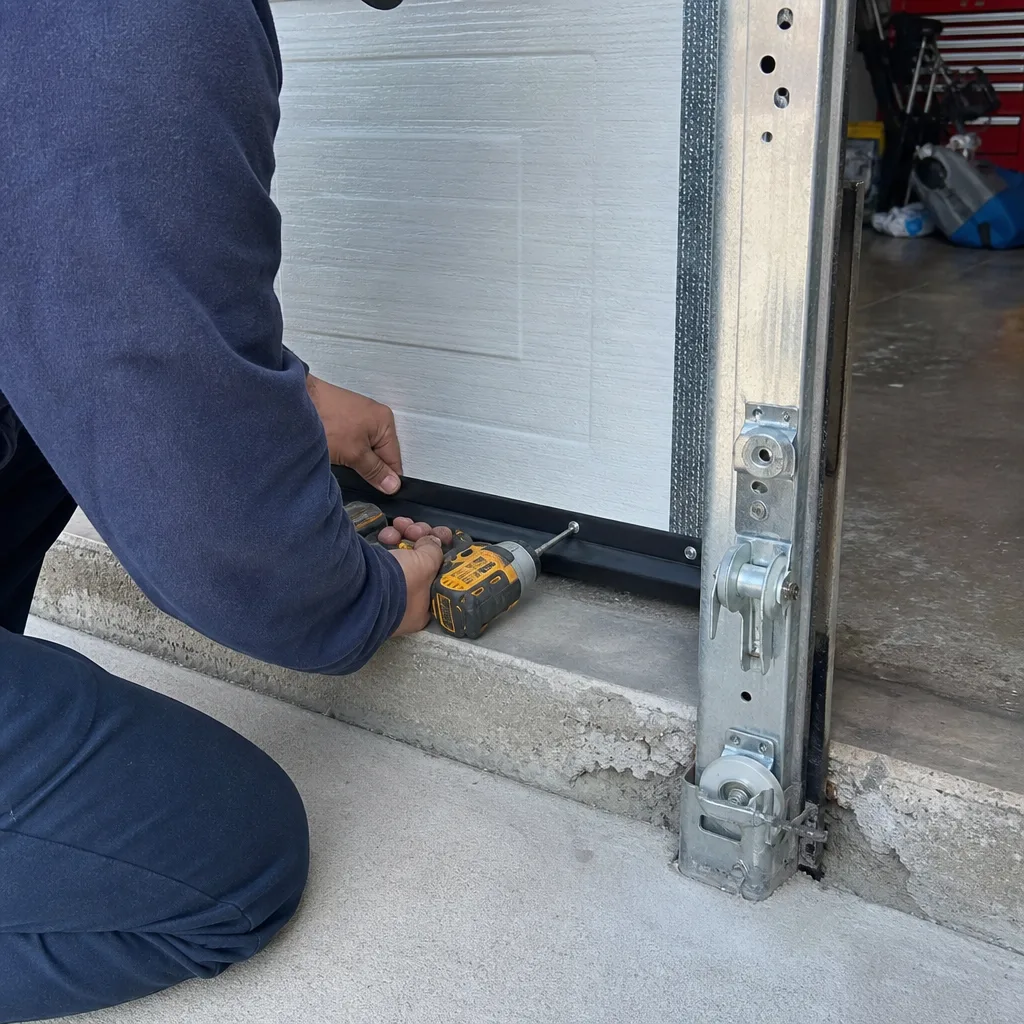
Redmond’s 164 wet days per year create a specific wear pattern for garage doors: bottom seals fail from standing water, freeze-thaw cycles damage panel seams and hardware, and the brief July-August dry window is your only reliable opportunity for paint, sealant, and deep cleaning work. A maintenance calendar built around these realities - October pre-winter preparation, January mid-winter checks, March post-winter audit, and July-August deep maintenance - prevents the emergency calls that otherwise cluster in January and February. The habits are simple: monthly visual inspection, quarterly balance and reversal tests, and seasonal tasks performed before weather makes them difficult. Document what you find, know when a condition exceeds homeowner maintenance, and choose a service provider who documents findings and quotes flat prices in writing before work begins.
Written by Marcus Deller, Owner at Servo Garage Doors Redmond, serving Redmond since 2015.